

.
A Roman Signet Ring
Bradford on Avon Museum, Wiltshire
.
,
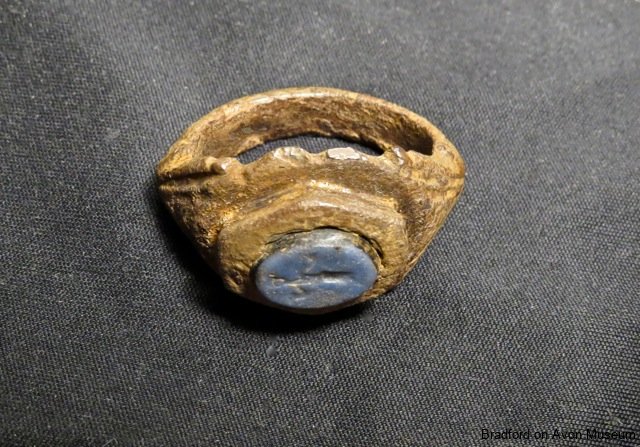
A piece of Roman bling – a chunky solid silver finger ring with its ‘jewel’ still in place, that was found in Broughton Gifford parish, to the east of Bradford on Avon.
It is fairly large and heavy (weighing 18 g) and cast in silver. The central part, or bezel, has a raised hexagonal collet that holds an oval piece of blue glass, into which there is a figure of a genius holding a cornucopia in one hand and a patera (a dish for offerings) in the other. Natural precious or semi-precious stones may have a figure engraved into them in the technique called by the Italian word intaglio, which gives a negative that would produce a positive if pressed into a wax or clay seal. However, as this is glass, the figure was probably cast from a mould. Like our other, but lighter, Roman ring it has shoulders each side of the bezel, but decorated with a chevron ornament. It has, of course, been tarnished and built up a patina during its 1,500 years or more in the soil.
Judging by its size, it was probably worn by a man, or perhaps by a woman over a gloved finger. We have no idea of how it was lost, or by whom, or where the owner lived or was travelling to, or the distress caused by its loss. You are free to make up your own story! We also have no idea of where it was made, but silversmiths in this country (Britannia) probably had the necessary skills. The origin of the silver is also not known, although silver was extracted not far away, in the lead mines of the Mendip Hills in Somerset.
Intaglio rings grew in popularity in the third century. An intaglio cornelian gemstone engraved with a figure holding a helmet, shield and spear was found in the excavation of the nearby Atworth Roman villa in 1937-8, but was subsequently lost.
The ring was found by a metal detectorist, Andrew Harrison, who is a member of the Chippenham and District Metal Detecting Club. He properly declared it to the Wiltshire Finds Liaison Officer at Salisbury Museum, under the Portable Antiquities Scheme. Being made of silver and over 300 years old, it qualified as treasure under the Treasure Act of 1996 and was valued by experts consulted by the British Museum. Bradford on Avon Museum expressed an interest in acquiring it because Broughton Gifford lies within the Museum’s official collecting area, as part of the former Bradford Hundred. The Museum is very grateful to the finder and to the owner of the land on which it was found for their donation.
This is the first time a metal detectorist’s find has come to the Museum -there must be much more out there.
.
.
.
.
.
.

The ‘intaglio jewel’ from the ring
.
.
.