

.
Cheesemaking in the Bradford Hundred
Rob Arkell, Bradford on Avon Museum Research Group, Wiltshire
.
Wiltshire was famous for two types of cheese: the Wiltshire Thin, an early season
cheese referred to by Daniel Defoe in the 1720s, which would have been similar to
Brie, and the North Wiltshire, made later in the year, which was a semi-hard cheese,
referred to in Jane Austen’s Emma and in Sense and Sensibility.
Cheese is first recorded in the Bradford Hundred in 1190 when the mowers of
Atworth were paid with a sheep, a cheese and two measures of corn. After 1600
most farms with some dairy cows will have had a dairy, or white room, where
cheese was made. Local wills show the equipment which was used in cheese-
making. In 1611 William Harding of Holt left a ‘newe house’ for brewing and
cheesemaking with a cheese rack and cheese press. In 1712 Thomas Harding left 22
cows and one bull, three cheese presses, ten tubs, thirty vats and one churn. The
will of Gabriel Chivers of Gaston Farm in Holt in 1729, who left 44 cows, refers to
the ‘dary house’ with three (cheese) presses, one large tub, five keevers (covers)
and one dozen cheesevates.
North Wiltshire cheese was sold locally at Bradford Leigh Fair, which had started in
1752. The amount sold was such that the prices achieved were reported in local and
national papers between 1788 and 1844. Skim cheese was the cheapest at 20s per
cwt, compared with ‘Best’ at 50s per cwt. Half-way between these was Half-Coward
or Half-Cow’d cheese which was made with ½ and ½ full cream and skimmed milk.
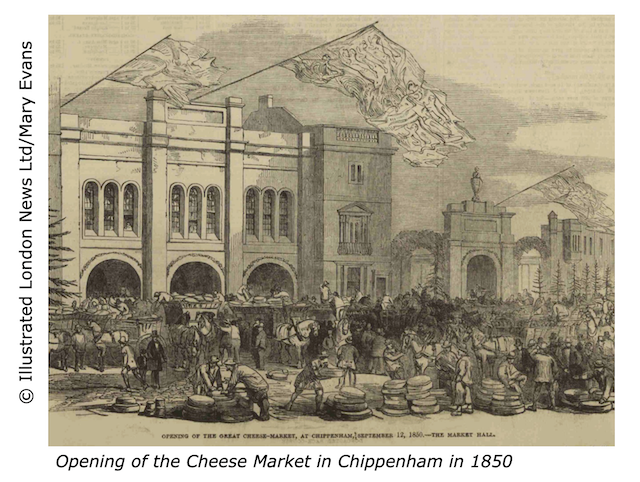
Cheese continued to be sold at the Fair until 1863 when the cheese trade had
passed to dedicated markets in Melksham and Chippenham.
Individual cheeses showed a considerable range of diameter and height. Single
and Double Wiltshire cheeses were between 12 and 16 inches in diameter.
Single cheeses, also known as Thins, were less than 3 inches thick and might
weigh up to 14 lbs. Double cheeses, also known as Thicks, Quarters or Broads
were twice as thick weighing up to 28 lbs. Loaf and Truckle cheeses were of a
smaller diameter, 4 to 7 inches, and were between 5 and 9 inches in height.
The Loaf weighed about 7 lbs and the Truckle 10 lbs.
Local cheesemaking continued with a farmer in Lower Wraxall winning the
North Wilts Loaf class at the British Dairy Association Show in the 1890s just
before the class was discontinued in 1903. In 1918 a cheese factory at Atworth was supplying the Twerton Co-operative Society in Bath.
Cheesemaking on farms ended in 1940 when wartime regulations forced all cheese to be made in factories.